
Notes from the Aventine | August-October 2026
Prompted by recent events, Abbot Primate Jeremias reflects on the papal visit to France and asks himself: What does the principal patron saint of Europe mean for the rest of the world?
3 October 2026
At the Roots of Europe:
Notes from the Aventine and the Rest of the World
Over the past few months, I have repeatedly reflected on how we Benedictines should deal with the fact that our founder is the principal patron saint of Europe, while today our monasteries are located on all continents and often flourish better outside Europe than here on the Old Continent.
This question occupied me back when I was President of the Missionary Benedictines, and even more so now as Primate of our entire Confederation.
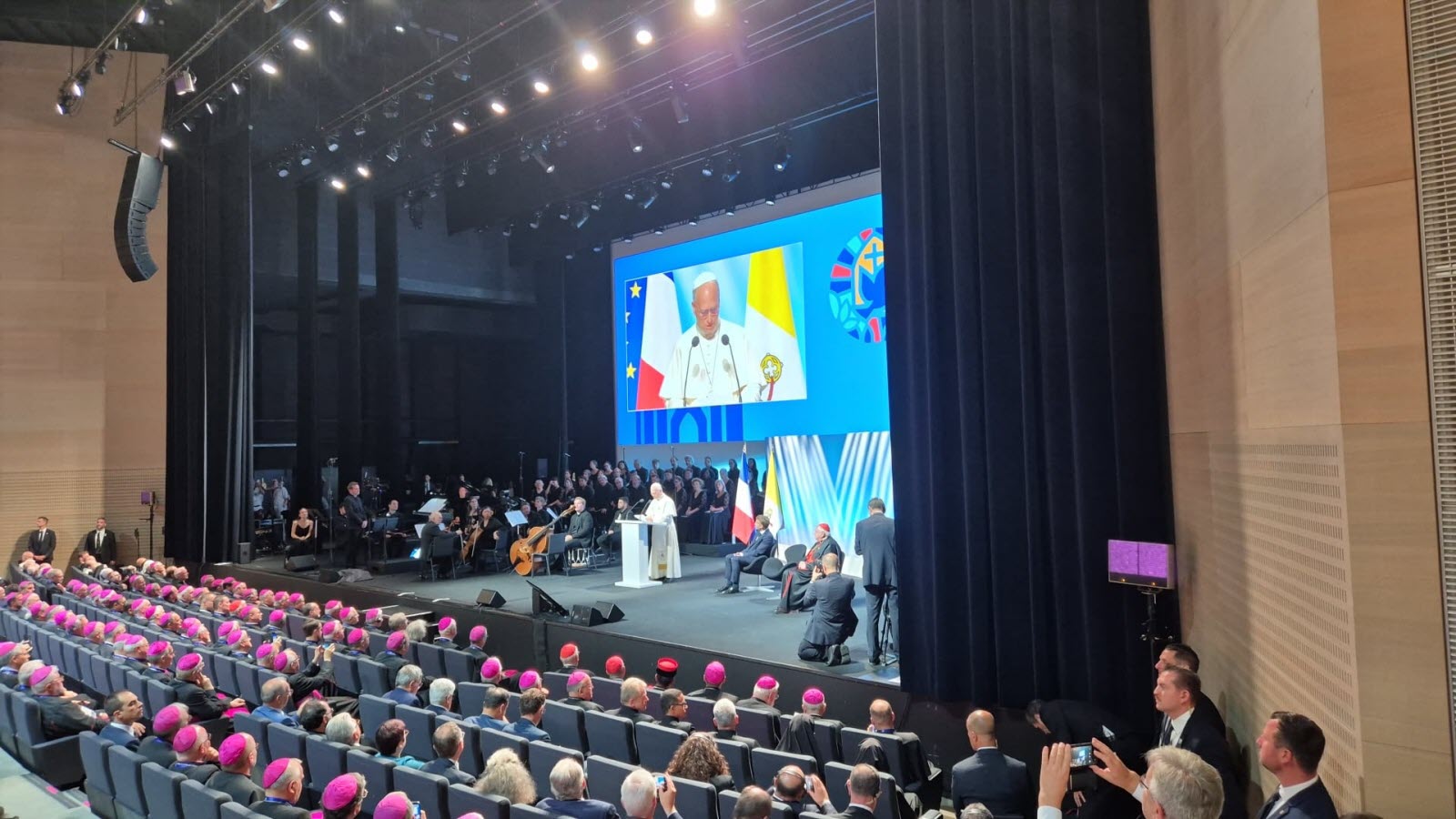
Into the middle of these reflections came Pope Leo's visit to France, which concluded on 28 September with a European fanfare in Metz. Pope Leo first spoke here about peace: in the Middle Ages, Metz was an Imperial Free City of Germany, became French in the early modern period, and was German once again from 1871 until the end of the First World War before returning to France. The suffering of the wars between France and Germany is deeply inscribed in the city and the region. The Pope also recalled the great work of peace after the Second World War that ultimately led to the creation of the European Union. Its founding fathers, Robert Schuman, Konrad Adenauer and Alcide De Gasperi, were men whose political thinking was strongly influenced by their Christian faith. The Abbot of Maria Laach, who was present in Metz, reminded us that all three had visited his monastery. Robert Schuman was also connected with Ligugé and En-Calcat.
Pope Leo then spoke in detail about the role of Saint Benedict in Europe, and his words deserve to be quoted:
In order to understand this long history, however, another father of Europe must not go unmentioned: Saint Benedict, whom Saint Pope Paul VI declared patron saint of Europe in 1964, describing him as a 'messenger of peace, builder of unity, teacher of civilisation' [1]. Assistance for the poor, the sick and the elderly; the education of children and universities; hospitals and medicine; architecture and engineering; the development of sciences; law and the organisation of cities and states themselves: so much in Europe was profoundly influenced by Saint Benedict and his monks! Without this monastic culture, European civilisation as we know it would not exist. Here in Metz, thanks among other things to the work of Saint Chrodegang, a Benedictine spirit of fraternity, community and sharing prevailed. From here, Gregorian chant spread throughout the Carolingian territories, bringing harmony and beauty to the entire continent.
To illustrate this Benedictine dimension, Benedictine abbots, abbesses and prioresses from France, Germany and Luxembourg were invited to Metz. I was also able to attend. We owe this to the initiative of Cardinal Aveline, Archbishop of Marseille and President of the French Bishops' Conference, who went a step further in his brief address by pointing out that the early Cistercian monks had already created a pan-European network, describing their General Chapter as a forerunner of the European Parliament.
These were inspiring words, but for me they were more than a historical tribute. They also helped me address the question that has occupied me for some time. We can look back with gratitude and a certain pride on a monastic tradition that shaped an entire continent. Yet this very tradition has never stopped at the borders of Europe.
The latter became clear to me once again in September when I had the opportunity to visit the communities of Gihindamuyaga and Sovu in Rwanda, and Ndanda in Tanzania: large convents of monks, nuns and sisters where the European founding generations have now given way to local religious. Almost all the dimensions of monastic service to the Church and society mentioned by Pope Leo are found in these houses, from pastoral care, schools and hospitals to spiritual deepening and the aesthetics of buildings and music, which reach their pinnacle in the dignified celebration of the liturgy. Benedict is among the fathers of Europe, but he does not belong to Europe. The principal patron saint of Europe is also the patriarch of a worldwide monastic movement that is alive and bearing fruit on every continent today.
Europe's reflection on its Christian and monastic roots continues. A small sign of this will be a ceremony at the European Parliament in Strasbourg on 20 October, where an assembly hall will be dedicated to Saint Benedict. The Nuncio to the European Union and I will both be taking part.
The Rule of Benedict, written in a time of violent upheaval and change, is full of messages for our turbulent times. I will mention just one: Benedict describes a life sub regula vel abbate—under a Rule and an abbot. The Rule comes first, followed only then by the personal authority of the elected superior. In this lies a political wisdom: power must not have the last word, but rather an order to which even the one exercising authority is subject. Authority stands in the service of this order – and both are ultimately meant to help people fulfil their deepest purpose in life in freedom.
And that certainly applies not only to Europe.
-
Notes from the Aventine | August-October 2026

A Glance into the Catalogus: Large Monasteries and Popular Names
Art, Vocation and Community: The Life of Fr Dunstan Massey OSB
Emeritus Archabbot Korbinian Birnbacher OSB Installed as Treasurer of Sant’Anselmo
Vocations in Benedictine Monasteries: Insights from a Master’s Thesis
Toward the Jubilee :
Positive progress