
DIM·MID Hosts Buddhist and Christian Meditation Workshop
A workshop at Sant’Anselmo in Rome brought together Christian and Buddhist monastics for a shared exploration of contemplative practice. Rooted in mutual respect, the dialogue opened new paths for understanding and spiritual enrichment.




7 July 2025
by Fr. Cyprian Consiglio, Secretary General of DIM·MID, and Br. Matteo Nicolini-Zani, National Coordinator of DIM·MID Italy
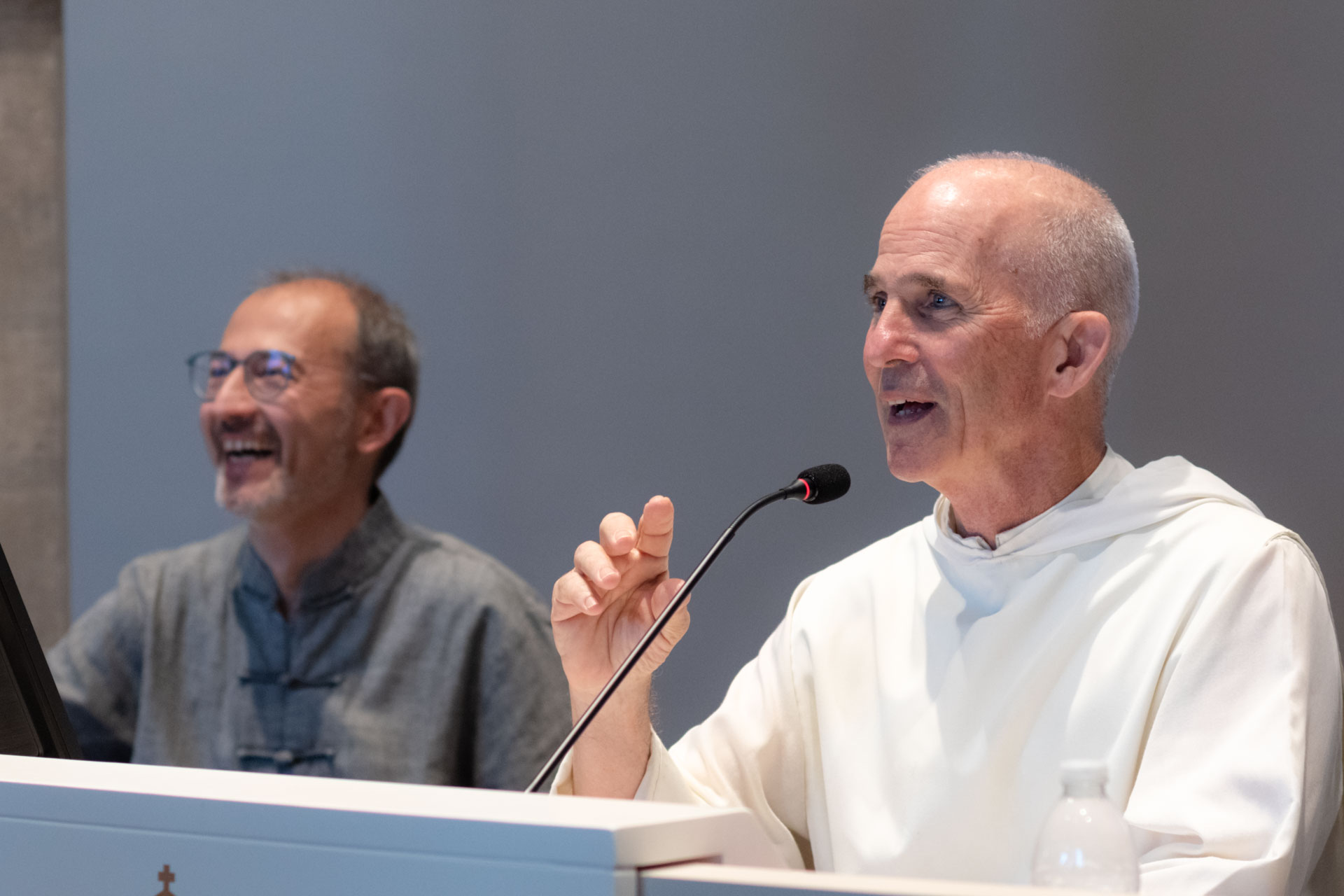
On the morning of Thursday, 26 June, a monastic interreligious workshop on meditation in the Buddhist and Christian perspectives was hosted at the Pontifical Athenaeum Sant’Anselmo in Rome. The main promoter of this event was DIM·MID (Dialogue Interreligieux Monastique · Monastic Interreligious Dialogue), an international organization that promotes and supports interreligious dialogue, especially at the level of spiritual experience and religious practice, between Christian monastic men and women and followers of other religions. The gathering was co-sponsored by other institutions, associations and groups: the International Buddhist Studies College (IBSC) of the Mahachulalongkornrajavidyalaya University (MCU), the Santacittarama Buddhist Monastery, the Italian branch of the World Community for Christian Meditation (WCCM), the Darsi Pace groups, and the Association for Insight Meditation (A.Me.Co.).
The workshop was the unexpected fruit of a recent spiritual experience that brought a group of five Christian monastics (two nuns and four monks) from Italy and Korea to Thailand. Last year, from 30 November to 7 December, the group, accompanied by a Catholic priest, was welcomed to take part in a week of the annual month-long meditation retreat organized by IBSC. The group was able to join all the other participants in an intensive practice of “mindfulness” or “insight” (vipassanā) meditation, offered by a team of meditation masters who teach at the IBSC. During those days, one of the meditation masters was Phramaha Hansa Dhammahaso, a Thai Buddhist monk with whom the Christian monastic group was glad to have a brief but intense moment of encounter. He welcomed the group very warmly, told them how happy he was that Christian monastics had come to practice insight meditation, and encouraged them to develop this practice within their Christian spiritual life.
For DIM·MID the visit in Italy by Venerable Hansa Dhammahaso, accompanied by Venerable Weerasak Abhinandavedi, a Thai monk, and Venerable Neminda, a Burmese monk, both lecturers at the same IBSC in Bangkok, was a blessed occasion for developing the partnership with IBSC, strengthening the bond of fraternity with the Thai Buddhist monks encountered last year in Thailand, and deepening our sharing with regard to our respective treasures in the area of meditation or contemplation.
Indeed, one of the major areas of overlap between Buddhism and Christianity is a long history of contemplative practices and meditation methods. Meditation is a spiritual common ground that our religious traditions share as a practice aimed at attaining their respective goals, namely liberation and salvation. Monastic life, both in Buddhism and Christianity, encourages monks and nuns to develop their spiritual life through several different means, and meditation is one of the principal ones. Against this background, the workshop at Sant’Anselmo was geared toward mutually exploring Buddhist and Christian meditation traditions, with a particular focus on helping the participants to grasp the theological principles and spiritual goals of both the Buddhist and Christian meditation paths.
We had two goals in mind. The first was to make – and to make together – a step forward in helping each other better know our living traditions in the area of what we call meditation or contemplation. By this face-to-face exercise, the Buddhist participants were able to gain a deeper awareness of what Christians mean when they speak about that particular form of prayer that they call meditation, silent prayer, quiet or hesychast prayer, and so on. And the Christians became more aware of the original meaning of practices conveyed by words such as “insight meditation” or “mindfulness.” The two presentations – one by Venerable Hansa Dhammahaso (Phra Medhivajarapundit), former director of IBSC, esteemed scholar and experienced meditation master, and the other by Sr. Benedetta Bucchi, a contemplative nun experienced in the Eastern Christian hesychast tradition and currently a Ph.D. candidate at Sant’Anselmo – approached the topic from two particular perspectives, namely, the Theravāda perspective from the Buddhist side, and the monastic perspective, from the Christian side.
These presentations clarified what are both the convergences and the divergences of Christian meditative prayer and Buddhist meditation practice. With this framework as a background, we were able to have a dialogue between the participants concerning the second focus of our workshop: “What possible interweaving is there of Buddhist and Christian meditation practices?” From the Christian perspective, this question sounds particularly challenging, since it deals with the issue of how Buddhist meditation could sustain and enrich the Christian practice of meditative prayer as a path of liberation and a way of communion with God. Our long, intense and fruitful dialogue was enriched by many contributions of several participants who shared insights from both their own theoretical understanding as well as from their lived –and living – experience of meditation.
It is our hope that this event represents only a first step of an ongoing dialogue about this topic that is crucial for both Christians and Buddhists, and particularly for monastics following the footsteps of the Buddha and the Christ.
Saint Bernard Abbey Elects 11th Abbot
Benedictines Mark the Centenary of Brother David Steindl-Rast OSB
New Abbot Elected at Conception Abbey
Limits of Hope?
Elections, Appointments, and Events | June-July 2026
Benedictine Moments During the Papal Visit to Spain