
Communio on the Aventine: Inside the Numbers at Collegio Sant’Anselmo
At Collegio Sant’Anselmo, 110 residents from 36 nations live, pray, and study—forming a living witness to Christian unity across cultures. Explore the demographic charts in the post.
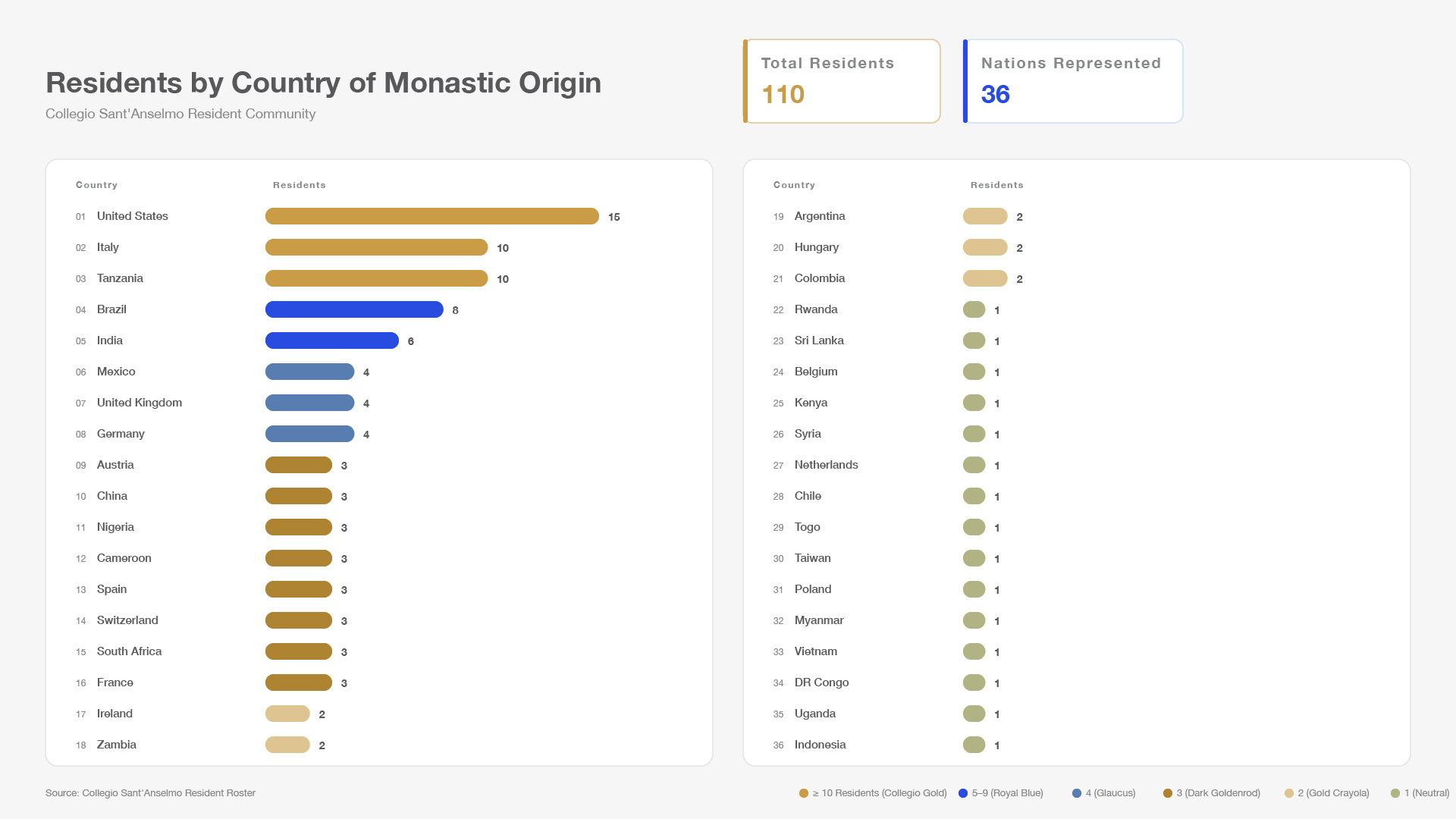
Click on the chart to expand the view.
18 November 2026
Editor’s note: It is a testament to the resident faculty and administration of Collegio Sant’Anselmo that the vibrant international character of our community feels so natural. New residents assimilate seamlessly, and we quickly take for granted a remarkable reality: As far as we know, our house is unique in its diversity. No other institution on earth brings together individuals from 36 different nations to live, work, and study in daily common life. It is a living, modern witness to the agape and philia at the heart of the true Christian calling.
For a typical student-resident at Collegio Sant’Anselmo, the day begins before dawn in the church, chanting Lauds and celebrating the Conventual Mass in Italian alongside confreres from every corner of the globe. Morning lectures follow — either downstairs at the Pontifical Atheneum Sant’Anselmo or across Rome at one of the city’s other pontifical universities — before the community gathers again at midday to pray Ora Media in Latin. At lunch, the refectory roars with conversation in Italian and a mosaic of native tongues. By evening, the rhythm culminates in Latin Vespers from the Antiphonale and supper in silence with a reading in Italian.
Every month, the resident community gathers for a cultural celebration hosted by one of our language and social groups. The evening features a Mass and festive meal, bringing together the traditional liturgical customs, culinary heritage, and music of their homeland.
In an era marked by an instinct for nations and cultures to turn inward, daily life on the Aventine Hill offers a quiet, lived counter-witness. Here, Saint Benedict’s Rule gathers 110 men from 36 countries into a single household. Rather than flattening cultural differences, common prayer, shared meals, and rigorous study transform them into a concrete school of communio—a living image of the Mystical Body of Christ, where many distinct members form one unified community.
A Self-Sustaining Schola
While many think of Collegio Sant’Anselmo primarily as an international residence for student monks, its demographic makeup reveals something far more intentional: a self-sustaining Benedictine schola ("school of the Lord’s service"). Roughly two-thirds of the house is dedicated to full-time academic study, while the remaining third sustains the intellectual, spiritual, and daily life of the institution.
Specifically, 71 residents are full-time students, actively mentored and cared for by 36 full-time professors, monastic officials, Curia staff, and lay volunteers. That operational backbone spans the entire life of the house—from the Abbot Primate, Prior, Subprior, and academic deans to the cellarer, economo, archivist, librarian, guestmaster, sacristan, and gardener. Two additional residents bridge both worlds, combining advanced studies with teaching or directing the community choir, while a permanent guest serves at the Vatican’s Dicastery for Promoting Christian Unity.
Intellectual Formation on the Aventine and Across Rome
Within the student body — comprising the 71 full-time students, the two dual-role residents, and one faculty member pursuing specialized studies — the Pontifical Atheneum Sant’Anselmo remains the primary academic home. Theology (TEO) draws the largest cohort with 25 students, followed closely by the Pontifical Institute of Liturgy (PIL) with 15 students and the Faculty of Philosophy (FIL) with 11. Smaller, specialized cohorts pursue Monastic Studies (TSM), the History of Theology (StT), Sacred Art, and preparatory language studies.
At the same time, 14 residents extend the Benedictine presence into the wider Roman academic landscape, studying at the Pontifical Gregorian University (PUG, 5 students), the Pontifical University of St. Thomas Aquinas / Angelicum (PUST, 5), the Pontifical Beda College (PCB, 2), the Pontifical Lateran University (PUL, 1), and the Pontifical Salesian University (UPS, 1).
Enrolled at Ateneo Sant'Anselmo
Enrolled at Other Roman Universities
A Shifting Global Center of Gravity
A look at the 36 nationalities represented at the Collegio reflects both deep continuity with historic monastic heartlands and a demographic shift toward the Global South. While the United States leads all nations with 15 residents and Italy follows with 10, Tanzania ties Italy for the second-largest national presence in the house (10 residents), ahead of Brazil (8) and India (6).
Europe, Latin America, Africa, and Asia are all robustly represented across the middle tiers — including Germany, Mexico, and the United Kingdom (4 residents each), alongside Austria, Cameroon, China, France, Nigeria, South Africa, Spain, and Switzerland (3 each). Another 20 nations contribute one or two residents apiece, stretching from Argentina, Colombia, and Chile to Rwanda, Sri Lanka, Vietnam, and Myanmar.
Nota bene: These numbers represent residents' monasteries of origin, not origin of birth.
Top nationalities represented
Monastic Roots and Universal Hospitality
Of the 110 residents, 86 are Benedictine monks (OSB) representing 15 Congregations and more than 60 monasteries worldwide. The Missionary Benedictines of Sankt Ottilien (OTTIL.) form the largest monastic group with 19 monks, followed by the Subiaco Cassinese Congregation (SUB.CAS., 12), the Annunciation (ANUN., 8) and American-Cassinese (AM.CAS., 8) Congregations, and the Congregation of Solesmes (SOL., 7). At the abbey level, two Tanzanian communities of the Ottilien Congregation lead the house in sending multiple confreres — Mvimwa Abbey (5 monks) and Ndanda Abbey (3 monks) — while 16 additional monasteries across four continents are each represented by two monks.
True to Chapter 53 of the Rule, which calls monks to welcome all who arrive as Christ, the cloister also extends generous hospitality to the wider Church. Living alongside the Benedictines are 17 diocesan priests and seminarians from 13 dioceses — ranging from the Archdiocese of São Sebastião do Rio de Janeiro (3 residents) and the Diocese of Nnewi in Nigeria (2) to dioceses in China, India, Indonesia, Poland, and Zambia — as well as two non-Benedictine students listed by country, a Cistercian (O.Cist.) professor, a Syriac Orthodox student from the Archdiocese of Damascus, and three lay volunteers.
Top Benedictine Congregations
Pentecost on the Aventine
Nowhere is the Collegio’s international character more audible than in the 18 primary languages spoken by its residents. English serves as the most common mother tongue (30 residents), followed by Spanish (12), Swahili (11), Italian (10), German (10), Portuguese (8), French (8), Hindi (6), and Chinese (4), alongside nine additional languages ranging from Arabic and Kinyarwanda to Hungarian and Vietnamese.
Nota bene: These numbers are based on the national language of the monastery of origin. In fact, the majority of the residents of the Collegio are necessarily bilingual, having learned Italian on their arrival. Many speak at least three languages, some four. Residents from the African continent are known to speak as many as five languages.
Primary Languages Spoken
By praying in Latin and Italian while dining, debating, and celebrating across nearly 20 mother tongues, the residents of Collegio Sant’Anselmo experience firsthand that genuine unity never requires uniformity. When these monks, diocesan priests, and scholars eventually return to their home abbeys, dioceses, and universities, they carry with them a living, powerful model of international communio built to serve a global Church.

A Glance into the Catalogus: Of Youths and Men
-
Communio on the Aventine: Inside the Numbers at Collegio Sant’Anselmo

Toward the Jubilee : Global Initiatives and New Digital Support

CIB Establishes International Office in Rome
Formed in the Cloister, Called into Breadth: The Legacy of Br Radbod Commandeur OSB

Navigating Artificial Intelligence: Autumn Day of Formation 2026