
Towards a Residential College for Benedictine Women Students
Sant’Anselmo is working to establish a residential college for Benedictine women students, offering a stable community for study, prayer and formation. Prof. Fernando Rivas OSB explains why it featured in Abbot Primate Jeremias’ address to Pope Leo.
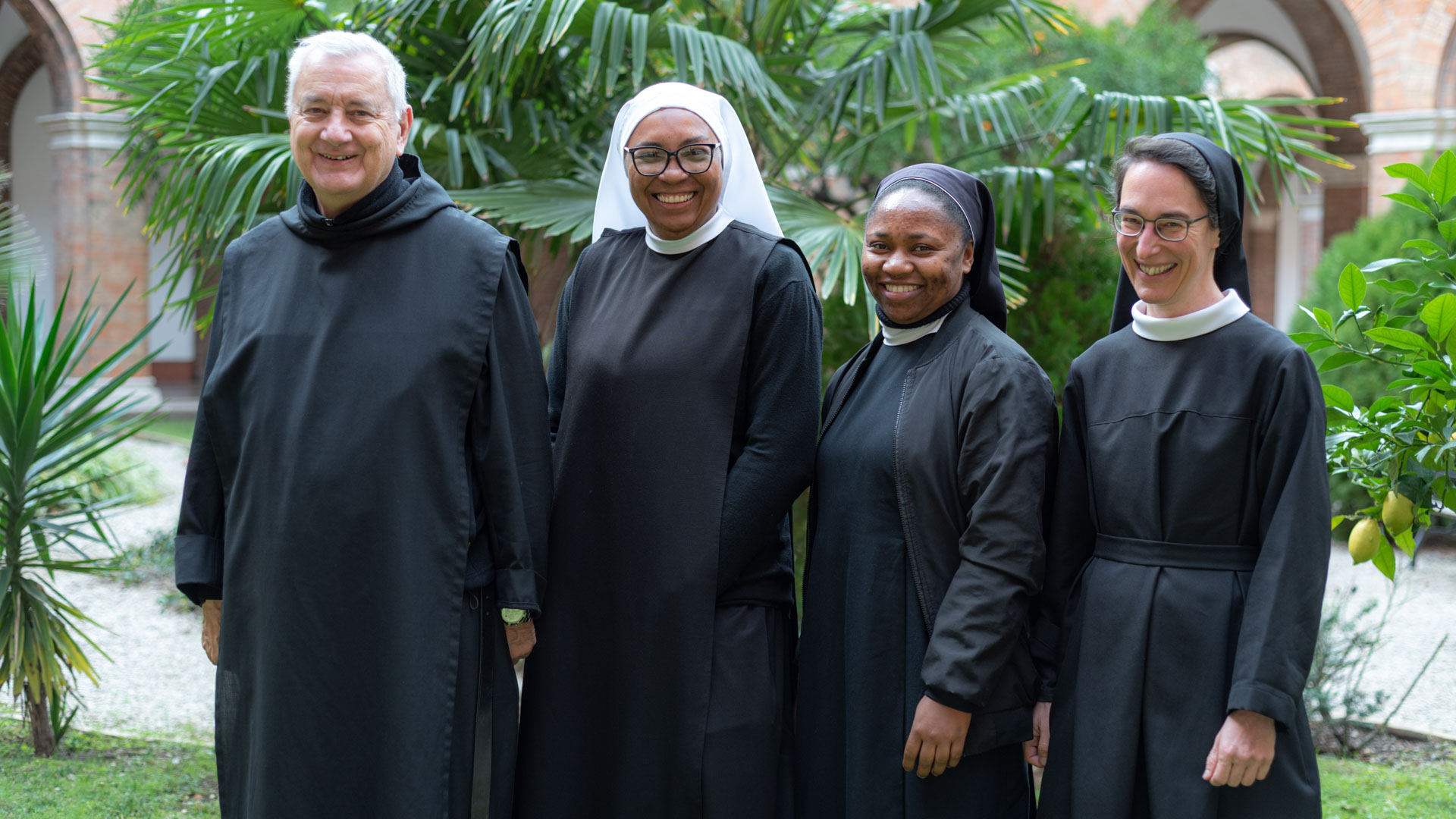
Prof. Fernando Rivas with Benedictine sisters enrolled at Ateneo Sant’Anselmo
4 January 2026
Prof. Fernando Rivas OSB
Coordinator of the Monastic Institute
Lecturer in Monastic Theology
Pontifical Athenaeum Sant’Anselmo
Throughout its history, the Pontifical Athenaeum Sant’Anselmo has consistently fostered the desire to offer its women students a true and stable residence: a place that could welcome them during their years of study and allow them, at the same time, to live an authentic experience of religious life in continuity with the monastic tradition as it is lived in their own monasteries. In the past, this desire took concrete form in the experience of the Santa Lioba Residence, which was located at the Cistercian Generalate House in Piazza Diana, also on the Aventine Hill. That community was guided by Prof. Sister Aquinata Böckmann OSB, whose presence ensured a serious and serene formative environment, deeply rooted in the Benedictine spirit. However, despite the quality of the project and the appreciation expressed by the students who lived there, this experience could not continue over time, primarily because it was impossible to secure the site as a permanent residence.
This interruption nevertheless left a significant gap—precisely the gap that the initiative had sought to fill. While monk students arriving in Rome find at Collegio Sant’Anselmo an environment that integrates community life, study and formation, it has no longer been possible to offer women students a comparable setting capable of guaranteeing a religious way of life consistent with their vocation. Over time, this led to a growing awareness that, in order to promote the development of future monastic generations, both male and female, it is essential to establish a women’s college that can offer nuns and sisters an environment of daily life that is familial, liturgical and formative, as already exists for monks.
Today the Abbot Primate, together with a team from the Atheneum, is working with determination and commitment to bring this project to fruition—a project that he himself presented to the Holy Father in his address of thanksgiving. The aim is to establish a true college for our women students, capable of offering them the opportunity to study at the Athenaeum in Rome within an appropriate community context, with qualified spiritual accompaniment and an atmosphere that fosters study, prayer and vocational maturation. This commitment arises from the conviction that the future of our monasteries depends to a large extent on the quality of the formation offered to those who will one day be called to lead or to form monastic communities. Today, candidates for religious life often receive, even in their countries of origin, a broad and well-articulated formation in many areas. Yet if they do not encounter a formative horizon that integrates this richness with the wisdom of our tradition, their formation will remain partial and incomplete.
For this reason, Sant’Anselmo seeks to realise as soon as possible the creation of a college that will allow our women students to grow in their vocation, to share fraternal life and to become fully integrated into the rhythm of study and prayer that characterises our tradition. At the same time, considerable effort is being devoted to securing a greater number of scholarships, in order to ease the financial burden borne by monasteries when they send their sisters to Rome. The objective is to enable communities to invest serenely in the formation of their candidates, confident that their path will be supported by benefactors who value and wish to encourage Benedictine life. In this way, the project of a women’s college will not only provide students with a suitable place for their growth, but will also contribute decisively to the renewal and vitality of our monastic communities.
From Norcia to Montecassino: Benedictine Jubilee Celebrations Begin
Br. Lukas of Nütschau Priory Leads Devotions in the Bundestag

Easter Notes from the Aventine | February-March 2026
Events, Elections and Appointments | February-March 2026

Benedictine Jubilee – Planning in Rome

Monk of Saint Meinrad Archabbey appointed Bishop of Belleville